
For a B2B company, one of its most important objectives is to create a continuous flow of qualified leads. And yet one simple question remains at the centre of most marketing and sales teams’ debates: should we focus on inbound lead generation or outbound leads?
The reality is that viewing the question as an either/or decision can hinder your growth. Both methods are powerful, but they operate in different ways. To build a predictable, scalable leads pipeline, you must know the basics of both, when to use each, and how to apply both for a steady flow of leads.
This guide has all your answers. We will distinguish between inbound and outbound leads and discuss their advantages and disadvantages.
By the end, you’ll have a useful framework for deciding which of these approaches to pursue and apply and how to blend them according to your business needs.
What Are Inbound Leads?

Consider a prospective customer who admits that he has a problem. Perhaps they are being held back by their current software, and maybe their website just isn’t drawing customers to them.
So, they go to Google, type a question, and your informative content, which explains how things work, ultimately provides the answer they are looking for. They fill out a form with their email to download your white paper. That individual is an inbound lead.
Put simply, an inbound lead is a customer who discovers you. They reach out because your brand’s content, visibility, or expertise caught their eye during their active research. It is known as a pull marketing strategy. You create resources, such as articles, videos, or tools that attract potential buyers to your company and earn their attention and trust over time.
These leads generally start with more immediate intent, since they have identified a need. They are at the awareness or consideration stage of the buyer’s journey, and they are looking for information upon which to base a decision.
What Are Outbound Leads?
Now picture a different scenario. Your sales reps use your prospecting tools to drill down and find a company that totally fits the ideal customer profile you decided on. The marketing director there hasn’t been looking for answers in the past but is growing and may be interested in what you have to offer. Your SDR writes a tailored email with a specific case study to offer. The director answers, curious to know. That is an outbound lead.
An outbound lead is a customer you actively solicit and contact directly. Here, you start talking to potential customers (who may or may not be looking for your solution). This approach is a push strategy. It involves proactively reaching out to someone through a cold email, phone call, or targeted advertising, generating interest, and creating demand.
Outbound gives you more control over the pace and which accounts you reach out to, but it can take more effort to engage with prospects who don’t have a pressing need or are looking for a solution.
Inbound vs Outbound Lead Generation: Difference At A Glance
It’s necessary to parse out these two models of performance, though you may often hear them used interchangeably, but they have a crucial difference:
| Aspect | Inbound Leads | Outbound Leads |
|---|---|---|
|
Core Approach |
Attract and pull |
Identify and push |
|
Initial Cost |
Higher upfront investment |
More predictable per-lead cost |
|
Speed to lead |
Slower build, long-term asset |
Faster initial results |
|
Buyer’s Stage |
Early (Awareness/Consideration) |
Can be any stage (mostly mid-funnel) |
|
Primary Channels |
|
|
|
Team Focus |
Marketing and Content Creation |
Sales Development and Prospecting |
Inbound Vs Outbound Lead Generation: Key Differences
Here are some key differences between inbound and outbound leads:
- Cost Structure and Timeline: Inbound requires substantial up-front investment in content and SEO, which in turn increasingly lowers the per-lead cost over years of time. Outbound leads normally provide a linear pay-to-get cost structure, meaning you will spend money on ads or a sales team to acquire leads.
- Scalability: Inbound content can win leads around the clock with no added effort. Scaling outbound usually means expanding the size and budget of your team.
- Lead Quality vs Control: Inbound leads are often marketing qualified, but their volume fluctuates unpredictably. Outbound leads provide you with more direct control over whom you engage (like particular companies or industries), although it also entails extra work to qualify the interest generated.
- Brand Impact: Inbound established long-term brand authority and trust. Outbound establishes immediate brand awareness, which may sometimes be considered interruptive if not carried out properly.
What Are Inbound Lead Generation Strategies?
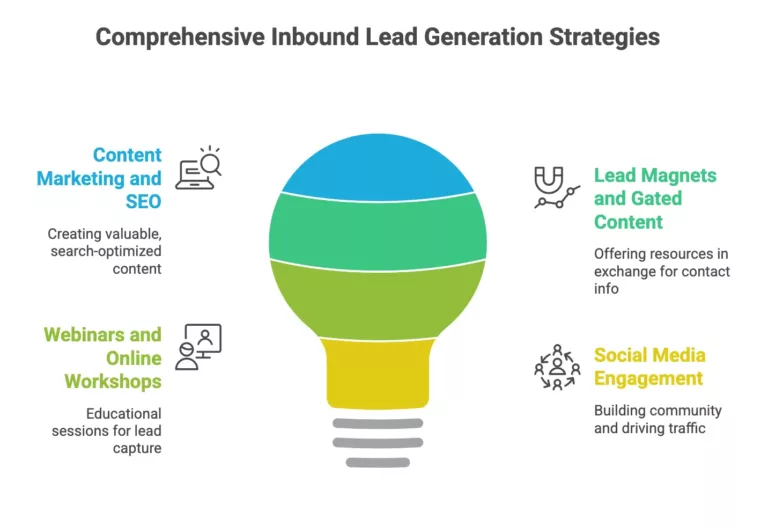
Inbound marketing means being found. Your goal is to create an attraction for your ideal customer. Here are the core inbound lead generation strategies:
- Content Marketing and SEO: You create blog posts, guides and tutorials that answer the exact questions of your audience. By making this content search engine optimised (SEO) you attract organic traffic that converts into leads via forms or subscriptions.
- Lead Magnets and Gated Content: Offer valuable, comprehensive resources, such as e-books, industry reports or templates for contact information. This technique turns visitors from an unidentified source into known leads.
- Webinars and Online Workshops: Offer live or recorded educational sessions that not only underline your expertise but also offer practical advice and direction. Participant registration is a strong form of lead capture.
- Social Media Engagement: Sharing insights and participating in conversations on platforms such as LinkedIn or X builds a community that directs engagement back to your website.
The common thread running through all of these strategies is value-first education. You are not selling a product or service; you are giving away insights which build trust and authority, making the eventual sales much more likely.
What Are Outbound Lead Generation Strategies?
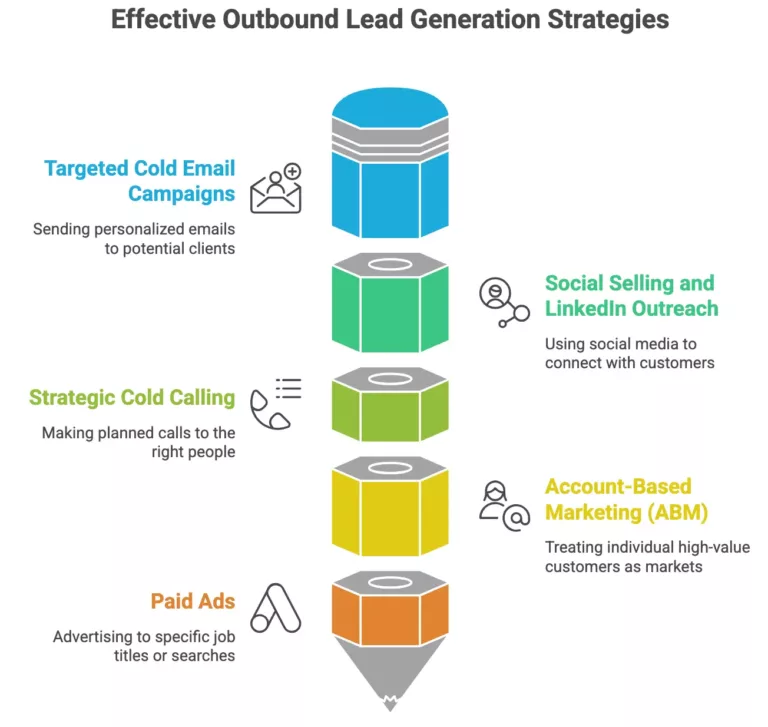
Outbound marketing, as the name suggests, means reaching out. Your goal is to spark a conversation with the right audience. Some effective outbound lead generation tactics are:
- Targeted Cold Email Campaigns: Sending personalised, value-driven emails to a list of potential prospects. Relevance, personalisation, and organised follow-up will be your keys to success.
- Social Selling and LinkedIn Outreach: Leveraging channels such as LinkedIn Sales Navigator to look up customers, participate in their discussions and send them personalised message requests.
- Strategic Cold Calling: While most people dread it, a carefully planned, consultative cold call to the right person in the right company can still open doors for you quickly.
- Account-Based Marketing (ABM): Marketing and sales teams coordinate actions that treat individual high-value customers as their own markets, using highly personalised ads, direct mail, and outreach.
- Paid Ads: Using platforms such as LinkedIn Ads or Google Search Ads, you can advertise your message to certain job titles or searches, generating direct leads.
To make an outbound approach work, you need laser-focused targeting, a strong message, and non-stop execution.
Advantages and Disadvantages Of Inbound Leads
Here are the pros and cons of inbound leads:
Advantages:
- Greater Intent and Trust: Leads that come your way are pre-educated and interested.
- It’s More Affordable Over Time: Great content will provide leads indefinitely, even well after the posting date.
- Established Brand Authority: Establishes your brand as a helpful expert in the industry.
- Meets Modern Buyers’ Needs: B2B buyers now do more than 70% of their research online before they ever speak to a salesperson.
Disadvantages:
- Results are Slow: In the beginning it can take 6 to 12 months to experience substantial SEO results.
- Efforts Required: Requires constant content creation and publishing.
- Less Direct Control: It is difficult to control when and how many leads you get.
- May Draw in Unqualified Leads: General materials can attract people who aren’t even close to buying.
Advantages and Disadvantages Of Outbound Leads
Here are the pros and cons of outbound leads:
Advantages:
- Speed and Predictability: You get qualified leads within days or weeks.
- Exact Targeting: You can target individual companies, sectors or titles.
- Instant Feedback: Rapid testing of message and product fit.
- Direct Pipeline Control: The sales team has immediate control of lead activity and volume.
Disadvantages:
- Higher Cost Per Lead: In the longer run, the cost per lead increases, especially for channels like cold calling and targeted ads.
- Lower Initial Intent: You are mostly creating demand rather than responding to it.
- Requires Skilled Execution: A skilled individual is necessary to implement outbound lead strategies, as poorly crafted emails or scripts can result in a low response rate.
- May Appear Disruptive: Brand perception can be damaged if not targeted correctly.
Factors To Consider In Inbound Vs Outbound Lead Generation
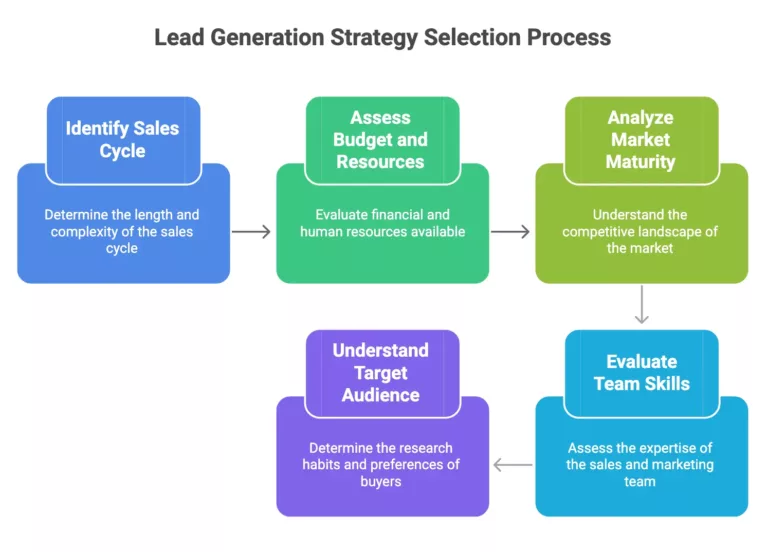
When it comes to inbound and outbound lead generation, here are some factors you should consider for the best results:
- Your Sales Cycle: Longer, more complicated cycles tend to get the most out of trust-driven inbound. Outbound can accelerate shorter cycles.
- Budget and Resources: Do you have the budget for long-term content creation (inbound) or a sales development team and paid ads (outbound)?
- Market Maturity: In a loud, mature market, inbound gets you attention. Whereas when launching a new product or niche, outbound can provide the initial buzz.
- Team Skills: Does your team include experienced writers and SEO specialists or trained SDRs?
- Your Target Audience: Are your buyers in the research mode, consuming lots of content online, or are they at an executive level that may respond to a short, relevant outreach?
Inbound vs. Outbound Leads: What’s the Best Lead Generation Method for Your Business?
For the vast majority of growing B2B organisations, it’s not inbound vs outbound lead generation; it’s a strategy that effectively combines both.
Focus On Inbound If:
You have the budget and patience for the long term, you operate in a competitive market where trust is essential, and your target audience are active online researchers.
Focus On Outbound If:
You need to quickly build your lead pipeline, have a clear and precise target account list, are new to the vertical, and have low brand awareness.
However, the best practice is to use both strategies in combination. Use inbound to power charge and warm up your outbound efforts. For example, in a cold email, reference a relevant blog post you’ve written or use a gated industry report as an offer after the first call. This strategy combines the trust of inbound with the proactivity of outbound.
If you want to learn more about how to generate more inbound and outbound leads for your B2B business, then see our guide: How To Generate Leads For B2B Business?
Get The Perfect Mix Of Inbound And Outbound Leads With ProInteractive
Choosing between inbound and outbound leads is a mistake that results in missed opportunities. At ProInteractive we are your partner in creating a single lead engine that doesn’t just drive activity; it works to deliver qualified leads continuously to your sales team.
Our approach is based on a simple and powerful principle: inbound builds the trust, and outbound starts the conversation. We blend both approaches to reach, get in front of, and engage your ideal customers at every stage of their process.
We Create An Inbound Structure That Brings You Qualified Buyers
Our content and SEO specialists develop inbound strategies which position our brand as a credible authority. We don’t simply create blog posts; rather, we create full-fledged responses to exact queries your buyers are looking for.
This approach builds trust, so when people encounter our brand, they feel we are more credible and trustworthy. This inbound magnet’s job is to continuously attract leads of higher intents or the ones who have self-identified this as the solution they’re looking for.
We Run Targeted Outbound Campaigns To Fill Pipeline
While our inbound strategy creates long-term value, our sales development reps don’t just wait. We work to discover and connect with your Ideal Customer Profile (ICP) through personalised emails and social outreach, so you don’t have to.
This way you are not just hoping for the right visitors to stumble upon your site but are instead putting your solution in front of accounts that matter most for growth.
We Qualify Leads With Smart Engagement Tracking
We track and store all interactions, from website visits to content downloads and email replies, in our single system. We don’t just give you names and email addresses; rather, we give you qualified leads with content: what they’ve consumed, how interested they are and, most importantly, their pain points. That way, your sales team is talking to educated, interested prospects, not dead-end contacts.
We Offer An Integrated Data-Driven Growth Solution For Businessess
You have one accountable partner overseeing the entire spectrum from brand awareness to qualified sales discussion. We carefully vet only qualified leads looking for solutions you are offering.
By paying only for each lead, you can ensure that your investment maximises and yields a high return on investment. With ProInteractive there is never a debate about strategy; you just get access to qualified leads.
Get Qualified Leads With ProInteractive Today
Quit debating how to strategise and just start getting qualified leads with ProInteractive. Whether you need to grow your business with a consistent flow of qualified leads or get instant access to leads for your startup, ProInteractive can help.
Do you want a pipeline of leads that is predictable and scalable? Partner with us to discuss your business needs and get instant access to qualified leads.
FAQs
Absolutely, although SEO is an investment of time, starting a targeted blog or several cornerstone pieces of content is low cost and can rapidly drive higher-quality prospects. Consistency matters more than having a big budget.
Yes, but they should be highly personalised and focused. Spray-and-pray email blasts fail. All great campaigns are relevant, have a clear value proposition and follow best practices.
This varies greatly. Inbound usually has a greater ROI when looking at it over multiple years because of how content can compound. Outbound can have a quicker, more direct ROI on a per-campaign basis. The combined method tends to maximise ROI.